What is a Branched RAG?
Learn what Simple RAG is, how Retrieval-Augmented Generation works, why it is useful, and why AI engineers should understand it.
What is a Branched RAG?
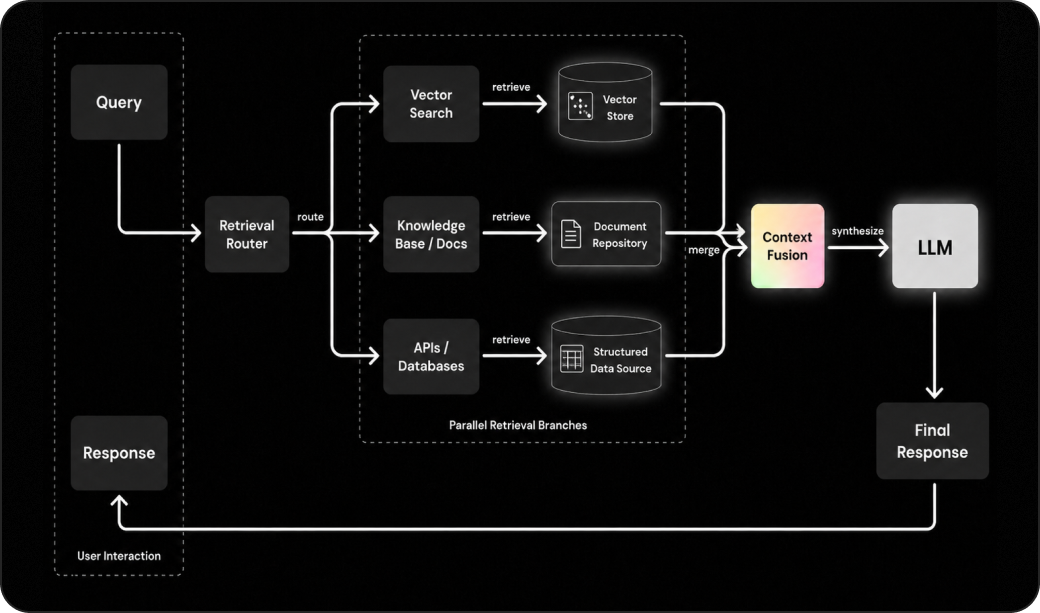
A Branched RAG is a more advanced version of RAG where the AI does not follow only one retrieval path.
Instead, it can split the user’s question into different branches, search different sources or angles, and then combine the useful information into one answer.
In simple words, a normal RAG system searches in one direction.
A Branched RAG system searches in multiple directions.
First, what is RAG?
RAG stands for Retrieval-Augmented Generation.
It means the AI first retrieves useful information from a knowledge base and then uses that information to generate an answer.
For example, if you ask a chatbot about your company refund policy, a RAG system can search the policy document first and then answer using the retrieved section.
If you are new to this, read What is a Simple RAG? first.
Why do we need Branched RAG?
Simple RAG works well when the question is direct.
For example:
What is our refund policy?
But some questions are more complex.
For example:
Compare our refund policy, pricing policy, and support policy, and suggest what should be improved.
This question may need information from multiple sources:
- Refund policy
- Pricing documents
- Support tickets
- Customer complaints
- Competitor notes
- Internal guidelines
A simple RAG system may search once and miss important context.
A Branched RAG system can create different retrieval branches for different parts of the question.
How Branched RAG works
A Branched RAG system usually works like this:
- The user asks a complex question
- The system identifies different parts of the question
- Each part becomes a separate retrieval branch
- Each branch searches for relevant information
- The AI compares or combines the retrieved information
- The final answer is generated from all useful branches
For example, for a business question, the branches may look like this:
- Branch 1: Search product documents
- Branch 2: Search customer support data
- Branch 3: Search pricing information
- Branch 4: Search competitor research
The final answer is created after looking at all branches.
Simple RAG vs Branched RAG
| Simple RAG | Branched RAG |
|---|---|
| Uses one retrieval path | Uses multiple retrieval paths |
| Good for direct questions | Good for complex questions |
| Searches one main source or query | Searches different sources or sub-queries |
| Easier to build | More flexible but more complex |
| Can miss broader context | Can collect context from many angles |
A simple example
Imagine you ask an AI assistant:
Should we launch this AI course for beginners?
A Simple RAG system may search only your course documents.
A Branched RAG system can search across multiple angles:
- What beginners are asking for
- What topics are already covered
- What competitors are teaching
- What your past students struggled with
- What skills are needed for AI engineering
Then it can combine these findings into a better answer.
This is why Branched RAG is useful for research-heavy and decision-heavy tasks.
Where Branched RAG is useful
Branched RAG is useful when the answer needs information from different places.
Common use cases include:
- Market research
- Legal research
- Academic research
- Customer support analysis
- Business strategy
- Product planning
- Financial analysis
- Multi-document comparison
- AI agents that use many tools
It is especially useful when the user’s question cannot be answered from one document alone.
How it connects to context engineering
Branched RAG is closely related to context engineering.
Context engineering is about giving an AI system the right information, tools, memory, and structure to complete a task well.
Branched RAG helps by selecting context from different paths instead of depending on one search result.
You can read more in What is Context Engineering?.
Benefits of Branched RAG
Branched RAG can make AI systems more useful because it can:
- Search from multiple sources
- Handle complex questions better
- Reduce missing context
- Compare different viewpoints
- Support deeper research
- Improve answers for multi-step tasks
This makes it useful for AI agents that need to reason across documents, tools, and workflows.
Limitations of Branched RAG
Branched RAG is powerful, but it is not always needed.
Some limitations are:
- It is more complex to build
- It can be slower than Simple RAG
- It may cost more because it performs multiple retrievals
- It needs good routing logic
- It still needs evaluation to check answer quality
For simple questions, Simple RAG is usually enough.
For complex questions, Branched RAG can be more useful.
Final thoughts
Branched RAG is a RAG system that can search across multiple paths before generating an answer.
Instead of depending on one retrieval step, it branches into different sub-questions, sources, or tools.
In simple words:
- Simple RAG searches one path
- Branched RAG searches multiple paths
- The final answer is created by combining the useful results
At AI Folks, we help learners understand practical AI engineering concepts like RAG, agents, context engineering, and AI workflows in a simple way.
Join the AI Folks community to learn how real AI systems are built step by step.